UVM News and Readings: February 2026
Maine’s TLM Community Thanks Fr. Parent for his Chaplaincy
On Gaudete Sunday, members of the TLM community gathered after Mass at the Lewiston Basilica of Ss. Peter & Paul to thank Fr. Robert Parent for his 17 years of service as Chaplain of the St. Gregory the Great Chaplaincy. The Chaplaincy was created following the release of Summorum Pontificum by Pope Benedict XVI, and Fr. Parent has been the chaplain from the beginning.
While Fr. Parent is retiring, he will continue to celebrate the Byzantine Liturgy on Saturday afternoons at 4:30 in the Basilica’s Lower Chapel. As for the Lewiston TLM, it has been incorporated into the purview of Prince of Peace Parish, with Fr. Dan Greenleaf assuming the role of pastor.
We thank you for your service, Fr. Parent, and we wish you a long and healthy retirement.
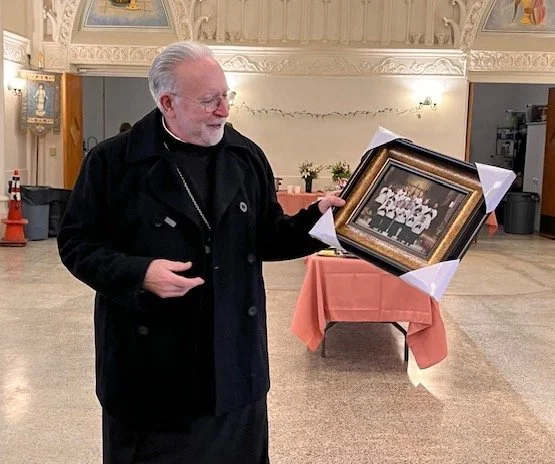
UVM presented Fr. Parent with a photograph of him with the Basilica Altar Servers taken last Easter.
UVM Launches Basilica Liturgical Fund
In light of the new organization of the TLM in Lewiston, the UVM board recently voted to establish a Basilica Liturgical Fund to help Prince of Peace Parish replenish the array of vestments and linens available for Fr. Greenleaf and (looking ahead) other priests to use in celebrating the Traditional Latin Mass at the Basilica.
For all who are interested in contributing, checks should be made payable to Una Voce Maine with “Basilica Liturgical Fund” written in the memo line. Checks may be sent to:
Una Voce Maine, PO Box 2574, South Portland, ME 04116-2574
People may also donate online through unavocemaine.org, but there, too, please add a note saying it is for the Basilica Liturgical Fund. Thank you very much for your support.
Readings on The Traditional Latin Mass
“The Holy Mass is both the means and sign through which the Lord bequeaths us his love. His whole life was a Eucharist to the Father, and it is in this, his Eucharist, that he wants to include all his people. Christian thanksgiving is fulfilled in and cannot be separated from the wholeness of the Holy Mass, itself a commemoration of the wholeness of the love of the Lord. Each celebration of Holy Mass is a unique introduction to the love of the Lord. No single Holy Mass is to be considered in itself, but rather it stands in relation to all other Holy Masses, which together form the indivisible sign of the whole and indivisible love of the Lord for his Church. In the Holy Mass this love is present both in its active and in its contemplative form. The prayers are contemplative, while the transubstantiation is action, both the action of the Lord and that of the priest, who represents the Church. Holy Communion is both action and contemplation, but it leads to a contemplation that is taken into daily life as both active and contemplative. Both forms of love come to fruition through receiving Holy Communion.” The Holy Mass, by Adrienne von Speyr
“The instruments of the liturgy—bells, oil, sacred vestments, prayers, and chants—play on a particular register, where memory and poetry, particularly scriptural and catechetical poetry, are based on the world of sense, but only in order constantly to go beyond it. Liturgy therefore requires active enquiry, and at the same time a very receptive state, what in the language of mysticism one might call a ‘passive’ state. Just like Scripture, the Christian liturgy speaks almost immediately to the soul of all believers, but it penetrates deeply only into those who listen to it attentively. We must therefore go through the church door, sign ourselves with holy water, and allow ourselves to be submerged in the luminous shadow of the sacred place, as Moses and Elijah were before us. A sacred preparation takes place, like that of the priest who prepares to celebrate the holy mysteries and who performs a series of actions, accompanied by prayer, as he clothes his body, and even more his soul, in the sacred vestments. That is what the minister is really doing (as are the faithful): he is clothing himself in the New Man of whom St Paul speaks, he is putting on Christ, in the place of the Old Man of sin. Or again, he is arming himself with spiritual armor, ready for the combat in which the Christian and spiritual life consists (Eph 5: 10–18).” A Forest of Symbols: The Traditional Mass and Its Meaning, by Claude Barthe
The Liturgical Year
Very Rev. Dom Prosper Guéranger Abbot of Solesmes, 1833-1875
The Season of Septuagesima
The Season of Septuagesima comprises the three weeks immediately preceding Lent. It forms one of the principal divisions of the Liturgical Year, and is itself divided into three parts, each part corresponding to a week: the first is called Septuagesima; the second, Sexagesima; the third, Quinquagesima.
All three are named from their numerical reference to Lent, which, in the language of the Church, is called Quadragesima, - that is, Forty, - because the great Feast of Easter is prepared for by the holy exercises of Forty Days. The words Quinquagesima, Sexagesima, and Septuagesima, tell us of the same great Solemnity as looming in the distance, and as being the great object towards which the Church would have us now begin to turn all our thoughts, and desires, and devotion.
Now, the Feast of Easter must be prepared for by a forty-days’ recollectedness and penance. Those forty-days are one of the principal Seasons of the Liturgical Year, and one of the most powerful means employed by the Church for exciting in the hearts of her children the spirit of their Christian vocation. It is of the utmost importance, that such a Season of penance should produce its work in our souls — the renovation of the whole spiritual life. The Church, therefore, has instituted a preparation for the holy time of Lent. She gives us the three weeks of Septuagesima, during which she withdraws us, as much as may be, from the noisy distractions of the world, in order that our hearts may be the more readily impressed by the solemn warning she is to give us, at the commencement of Lent, by marking our foreheads with ashes.
February 18 — Ash Wednesday
Yesterday, the World was busy in its pleasures, and the very Children of God were taking a joyous farewell to mirth: but this morning, all is changed. The solemn announcement, spoken of by the Prophet, has been proclaimed in Sion: (Joel 2) the solemn Fast of Lent, the Season of expiation, the approach of the great Anniversaries of our Redemption. Let us, then, rouse ourselves, and prepare for the spiritual combat.
But, in this battling of the spirit against the flesh, we need good armour. Our holy Mother the Church knows how much we need it; and therefore does she summon us to enter into the House of God, that she may arm us for the holy contest. What this armour is we know from St. Paul, who thus describes it: “Have your loins girt about with Truth, and having on the Breast-plate of Justice. And your feet shod with the preparation of the Gospel of peace. In all things, taking the Shield of Faith. Take unto you the Helmet of Salvation, and the Sword of the spirit, which is the word of God“ (Ephesians 6:14-17) The very Prince of the Apostles, too, addresses these solemn words to us: “Christ having suffered in the flesh, be ye also armed with the same thought“ (1 Peter 4:1) We are entering, today, upon a long campaign of the warfare spoken of by the Apostles: — forty days of battle, — forty days of penance. We shall not turn cowards, if our souls can but be impressed with the conviction, that the battle and the penance must be gone through.